Last updated 2026-07-23
TL;DR
Assisted living is licensed, non-medical residential care that helps people with daily tasks like bathing, meals, and medication reminders. It differs from a nursing home (skilled, medical, Medicare-certified) and overlaps with "group home," a broader term covering small licensed homes for seniors, IDD, mental health, or recovery populations. Medicare doesn't pay room and board; Medicaid sometimes covers services through HCBS waivers.
What is assisted living, in plain terms?
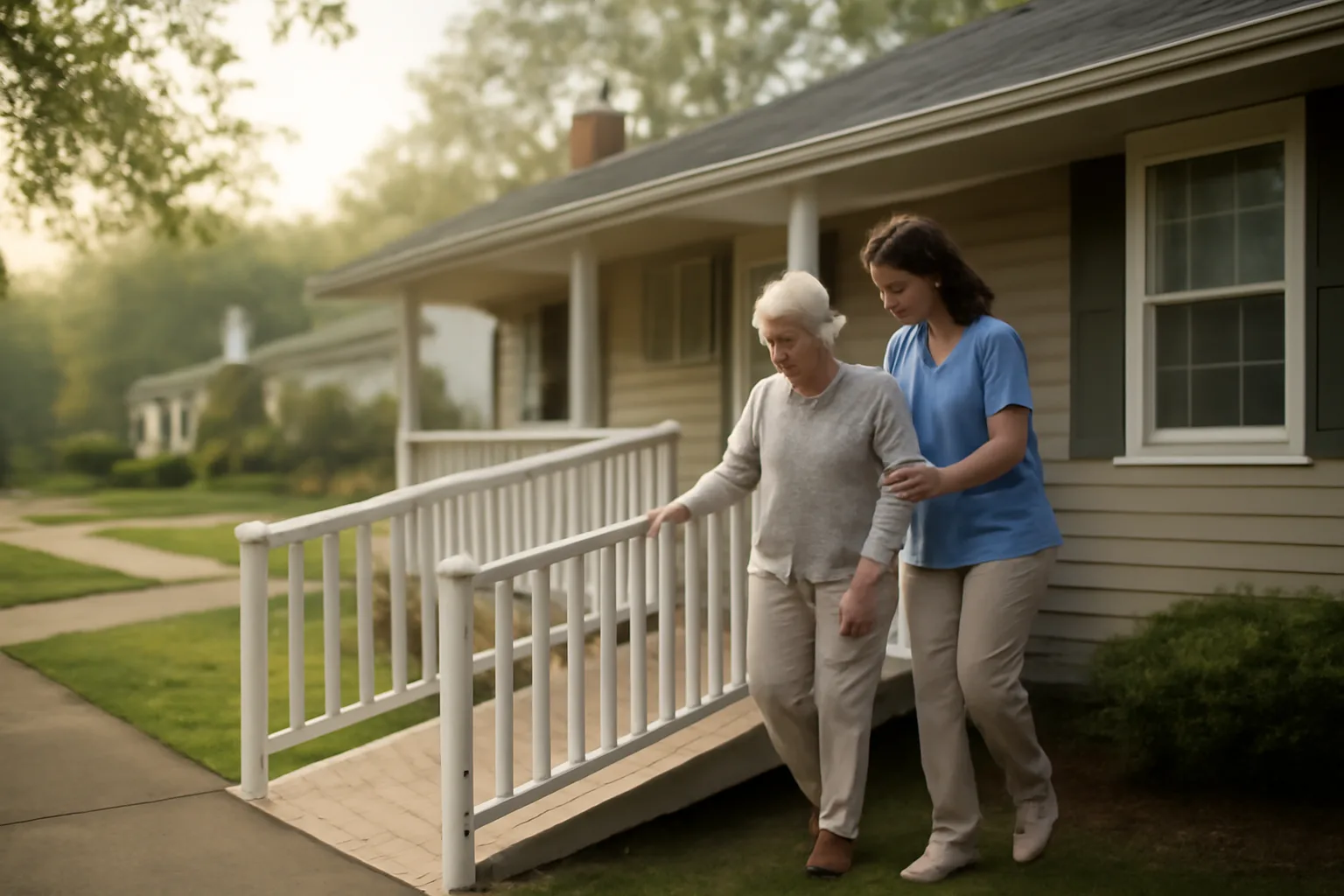
Assisted living is a type of long-term care that pairs a private or semi-private apartment with help for daily tasks: bathing, dressing, medication reminders, meals, and general supervision. It's licensed as a residential and personal-care model, not a medical one. Nobody in a standard assisted living building is running IVs or managing a ventilator. That's a nursing home's job. If you typed "assisted living IL" hunting for Illinois-specific rules, here's the short version: Illinois licenses these buildings as "assisted living establishments" through the Illinois Department of Public Health, under the Illinois Assisted Living and Shared Housing Act, 210 ILCS 9. Every state runs its own version of this license under a different name, different statute, and a different fee schedule, so treat the specifics below as a national baseline and confirm exact numbers with your state licensing agency. There's no single federal definition of assisted living. CMS and Medicaid.gov both treat it as a state-regulated residential setting, separate from a Medicare-certified nursing facility [1]. That single fact explains most of the confusion people have about coverage, inspections, and what "license" even means here. For a broader walkthrough of how licensing works building by building, see our assisted living overview.
What is an assisted living facility, exactly?
An assisted living facility is the licensed building or business entity itself, the physical place approved by a state agency to house residents and deliver personal-care services. It can be a converted single-family home with three beds or a 120-unit campus with a dining hall and activity director. The license type, not the building size, is what makes it "assisted living" in the state's eyes. Naming is a mess across the country, and that's on purpose (or at least on fifty separate legislatures never coordinating). California calls the small version a Residential Care Facility for the Elderly. Georgia uses "personal care home." Michigan and Oregon use "adult foster care" for smaller homes. Illinois splits the category into "assisted living establishment" and "shared housing establishment" under 210 ILCS 9. If you're comparing our assisted living facility breakdown against your own state's regulations, expect the label to differ even when the underlying model is nearly identical. According to CDC's National Post-Acute and Long-Term Care Study, the U.S. has roughly 30,000 licensed residential care communities, and most are licensed for fewer than 25 beds [2]. That's an important number for anyone picturing a giant senior living campus: most assisted living operations are small businesses, not corporate towers. For a sense of how these look at scale nationally, our assisted living facilities page compares formats side by side.
What is a group home, and how is it different from assisted living?
"Group home" is the broader, older term. It usually means a staffed residential home, often 3 to 16 beds, serving a specific population: people with intellectual or developmental disabilities (IDD), people with serious mental illness, people in recovery from substance use, or, in some states, seniors who need help with daily activities. Assisted living is really one flavor of group home, the one built specifically around aging adults and ADL support. The licensing agency differs by population even within the same state. A senior assisted living home might answer to the state health department or department of aging. An IDD group home more often answers to a developmental disabilities agency and is frequently funded through a Medicaid Home and Community-Based Services (HCBS) waiver rather than private pay. A recovery residence might not require a state operating license at all in some states, just a certification from a recognized recovery housing body, while in others it needs a full behavioral health license. The Administration for Community Living notes that HCBS programs exist specifically "to help older adults and people with disabilities... live in their own home or in a home-like community setting" rather than an institution. That's the philosophy behind both assisted living and most group homes: keep people out of hospitals and nursing facilities as long as it's safe to do so. If you're deciding which license path fits your plan, the population you intend to serve should drive that decision before you pick a building or a name for the business.
What is the difference between assisted living and a nursing home?
| Licensing body | State health/aging agency | State agency + CMS certification | |
|---|---|---|---|
| Care model | Personal care, non-medical | Skilled nursing, medical | |
| Nurse staffing | Varies by state, often no federal mandate | RN required 8+ hrs/day, licensed nurse 24 hrs (42 CFR 483.35) | |
| Medicare pays room/board? | No [1] | Yes, for short skilled stays meeting criteria | |
| Typical stay length | Months to years | Short-term rehab or long-term custodial | |
| Room type | Private/semi-private apartment | Private/semi-private hospital-style room | People often ask this question while comparing options for a parent. The honest short answer: if someone needs help getting dressed and remembering pills, assisted living usually fits. If someone needs daily skilled nursing, wound vacs, IV antibiotics, or post-surgical rehab, that's a nursing home's job, at least temporarily. |
The core difference is medical acuity and federal certification. Assisted living is a state-licensed residential and personal-care setting. A nursing home (also called a skilled nursing facility) is a state-licensed and, usually, Medicare/Medicaid-certified medical facility built to handle higher-acuity residents who need round-the-clock nursing care, wound care, IV therapy, or rehab after a hospital stay. Federal rule requires Medicare-certified nursing facilities to have a registered nurse on duty at least 8 hours a day, seven days a week, and a licensed nurse (RN or LPN) on duty 24 hours a day, per 42 CFR 483.35. Assisted living has no equivalent federal staffing rule; nursing coverage requirements, where they exist at all, are set state by state. | Feature | Assisted living | Nursing home |
What does assisted living actually provide day to day?
Most licensed assisted living operations provide three meals a day plus snacks, medication management or reminders, help with bathing and dressing, housekeeping and laundry, 24-hour staff presence (not necessarily nursing staff), an emergency call system, and some form of social or recreational programming. Many also coordinate transportation to medical appointments. What it typically does not provide: skilled nursing, physical or occupational therapy as a covered service, ventilator or feeding-tube management, or hospital-level monitoring. The National Center for Assisted Living describes the setting as built around a "social model" of care rather than a medical one, meaning the emphasis is independence and dignity, with medical needs handled by outside home health agencies, hospice, or a resident's own physicians as needed. That distinction matters for licensing too. States generally cap the level of care an assisted living license allows (sometimes called a "negotiated risk" or "level of care" ceiling), and a resident whose needs exceed that ceiling has to either bring in outside skilled nursing support or move to a higher level of care. If you're weighing an at-home version of this model instead of a facility, our assisted living at home page covers how that setup differs on the licensing side.
How much does assisted living cost, and how does it compare to a nursing home?
Costs vary enormously by state and even by county, so treat any national number as a rough anchor, not a quote for your market. The Genworth Cost of Care Survey has tracked these figures for years and puts the national median assisted living cost around $5,350 a month based on its most recent full survey cycle [3]. Home health aide services and nursing home care both run higher on average, largely because they involve more direct, hands-on medical labor. A few things drive local price swings: staffing costs in that labor market, whether the state has a lot of small owner-operated homes versus corporate chains, real estate costs, and how much competition exists nearby. Rural areas with few licensed beds sometimes charge more, not less, simply because there's no competing option down the street. Most assisted living is paid privately, out of pocket or through long-term care insurance, at least at first. If you're comparing local pricing before opening or before placing a family member, our senior assisted living facilities near me guide walks through how to shop that market realistically instead of relying on a single national average.
Does Medicare cover assisted living facilities?
No. Medicare does not pay for the room-and-board or day-to-day custodial care costs of an assisted living facility. As Medicare.gov puts it, "Medicare doesn't cover long-term care (also called custodial care) if that's the only care you need" [1]. Assisted living's core service, help with daily activities, falls squarely into that custodial-care category. What Medicare can still cover for someone living in assisted living: doctor visits, Part B outpatient therapy, durable medical equipment, and hospice care under the normal Medicare rules that apply anywhere a beneficiary lives. Medicare Advantage plans have also started offering limited supplemental benefits (like some home modifications or meal delivery) in certain plans, but that's a plan-level extra, not a blanket assisted living benefit, and it varies by plan and year. This is one of the most common and most expensive misunderstandings families run into. People assume "Medicare will cover it eventually" the way it covers a hospital stay. It won't. Planning for assisted living costs generally means private funds, long-term care insurance, or, for those who qualify financially, a state Medicaid HCBS waiver covering part of the service cost.
How does Medicaid help pay for assisted living or group home care?
Medicaid can help, but not the way most people expect, and not the same way in every state. Medicaid.gov describes Home and Community-Based Services as programs that "provide opportunities for Medicaid beneficiaries to receive services in their own home or community rather than institutions or other isolated settings". Many states use an HCBS waiver to pay for the service component of assisted living or a group home (staff time, personal care, medication management) for residents who meet both a financial and functional-need test. Room and board is usually excluded from that waiver payment. Residents typically cover the housing portion separately, often through Supplemental Security Income (SSI) or a state supplemental payment designed for exactly this gap. That split (services covered, room and board not) trips up a lot of new operators building a budget model. Coverage also depends heavily on population. IDD group homes are far more likely to have solid, long-standing Medicaid HCBS or ICF/IID funding pathways than senior assisted living, where waiver slots are often limited and waitlists exist in many states. Before assuming Medicaid will fund your census, call your state Medicaid agency directly and ask what waiver, if any, applies to your specific license category and population. The license type and the funding source are two separate approvals, and you need both lined up.
How do I start a group home? (the real steps)
Here's the sequence that actually works, in the order it needs to happen: 1. Decide your population and program model first. IDD, mental health, recovery, and senior assisted living each answer to different licensing agencies and different funding streams, so this choice drives everything downstream. 2. Set up your business entity, get an EIN, and get basic liability and business insurance sorted. The Small Business Administration has general startup guidance that applies to any licensed care business, though it won't cover your care-specific licensing steps. 3. Confirm the zoning classification for your property before you sign a lease or close on a house. Occupancy limits, parking requirements, and "group residential use" definitions vary by municipality, and a property that looks perfect can be zoned wrong. 4. Write your policies and procedures manual: medication management, emergency and disaster planning, resident rights, grievance procedures, staffing plan, and infection control. This is usually the single biggest paperwork bottleneck for first-time operators, mostly because state agencies want to see it structured a specific way, and generic templates off the internet rarely match. 5. Submit your license application with your facility plans, staffing plan, and financial documentation to the state agency. 6. Pass your fire and life-safety inspection. Most states apply some version of the NFPA Life Safety Code to residential care occupancies, plus a separate health/environmental inspection. 7. Hire staff, run required background checks, and complete state-mandated training hours before opening (exact hour requirements are state-specific; confirm with your state licensing agency). 8. Schedule and pass the pre-licensing survey. 9. Receive your license, open, and prepare for periodic renewal inspections going forward. Building steps 4 and 5 from a blank page is where most first-time operators lose the most time and money on consultants. The $299 State Group Home Licensing Kit, built through GroupHomePath's licensing kit builder, packages state-matched policy templates and staffing plan documents so you're not reinventing a 40-page manual from scratch.
What licensing, staffing, and inspection requirements should I expect?
Expect these categories to show up in some form no matter which state you're in, even though the specific numbers differ: administrator training and certification hours, background check and fingerprinting requirements for all staff, minimum staff-to-resident presence (some states set exact ratios, others just require "sufficient staff to meet resident needs"), minimum square footage per resident, fire marshal sign-off, and both initial and periodic (usually annual) inspections. The National Center for Assisted Living compiles a state-by-state regulatory review comparing these requirements across every state, which is worth pulling up before you draft anything, because it shows you what your specific state actually asks for instead of a national guess. Illinois, for example, licenses assisted living establishments and shared housing establishments under separate provisions of 210 ILCS 9, each with its own resident criteria and staffing expectations, and applicants work through the Illinois Department of Public Health's assisted living program. Don't assume your state's rules mirror a neighboring state's, even when the population and building size look identical. Fee amounts, required training hours, and inspection frequency are exactly the kind of detail that changes from one legislative session to the next, so pull the current version directly from your state licensing agency's own site rather than relying on a blog post (including this one) for the exact dollar figure. If you want that state-specific pull-together done for you instead of hunting through fifty different agency websites, that's the whole reason a matched licensing kit exists in the first place.
Frequently asked questions
What is assisted living?
Assisted living is a licensed, non-medical residential care setting where staff help residents with daily tasks like bathing, dressing, medication reminders, and meals, while residents live in a private or semi-private apartment. It's regulated by state health or aging agencies, not certified as a medical facility by Medicare, and the exact rules and name for the license vary by state.
What is a group home?
A group home is a staffed residential home, typically 3 to 16 beds, licensed to serve a specific population such as people with intellectual or developmental disabilities, mental illness, substance use recovery needs, or seniors needing daily living support. Assisted living is essentially the senior-focused version of a group home, licensed under its own state category.
What is an assisted living facility?
An assisted living facility is the physical building and licensed business that provides assisted living care, ranging from a converted three-bed house to a large campus with over 100 units. States use different names for this license (assisted living establishment, residential care facility for the elderly, personal care home), but the underlying model is similar: housing plus non-medical personal care.
What is the difference between assisted living and a nursing home?
Assisted living is a residential, non-medical setting for people who need help with daily tasks. A nursing home is a medical facility, usually Medicare/Medicaid-certified, for people needing skilled nursing, rehab, or round-the-clock medical monitoring. Federal rule requires certified nursing homes to keep an RN on duty at least 8 hours a day and a licensed nurse 24 hours a day; assisted living has no equivalent federal staffing mandate.
Does Medicare cover assisted living facilities?
No. Medicare does not pay for assisted living room and board or custodial care, since that falls under long-term custodial care, which Medicare explicitly excludes. Medicare can still cover separate medical services a resident receives there, like doctor visits, Part B therapy, or hospice, but it will not pay the facility's monthly rate.
Does Medicaid cover assisted living?
Sometimes, and only partly. Many states use a Medicaid Home and Community-Based Services (HCBS) waiver to cover the service portion of assisted living or a group home for eligible low-income residents who meet a functional-need test. Room and board is typically excluded and paid separately, often through SSI. Coverage and waiver availability vary significantly by state and population.
How do I start a group home?
Pick your population and program model first, then set up your business entity, confirm zoning for your property, write a full policies and procedures manual, submit your license application to the state agency, pass fire and health inspections, hire and train staff, pass the pre-licensing survey, and get your license before opening. Requirements and timelines differ by state.
What licenses do I need to open an assisted living facility?
You need a state-issued assisted living or residential care license from your state's health or aging department, plus typically a business license, a fire/life-safety inspection sign-off, and sometimes a separate zoning or occupancy permit. Exact requirements, forms, and fees differ by state, so confirm the specific list with your state licensing agency before budgeting.
How much does assisted living cost?
The national median is around $5,350 a month according to the Genworth Cost of Care Survey, but actual costs vary widely by state, region, and level of care needed. Nursing home care generally costs more, since it involves higher medical staffing. Always compare local pricing rather than relying on a single national figure.
What's the difference between assisted living and independent living?
Independent living is housing for seniors who don't need daily personal-care help, usually with amenities like meals and activities but no licensed care staff. Assisted living adds licensed, hands-on help with daily tasks like bathing and medication management. Independent living communities generally aren't state-licensed as care facilities the way assisted living is.
Can a group home operate without a license?
Almost never legally. Nearly every state requires a license or certification to operate a residential home providing personal care, supervision, or medication management to unrelated residents, regardless of the population served. Operating unlicensed typically exposes you to fines, forced closure, and liability if something goes wrong. Confirm your state's specific licensing threshold with the relevant agency.
How long does it take to get an assisted living or group home license approved?
Timelines vary widely by state and by how complete your application package is, ranging from a couple of months to closer to a year in some jurisdictions, especially if fire, health, and zoning inspections all need scheduling in sequence. There's no guaranteed or fast-tracked timeline; confirm current processing times directly with your state licensing agency.
What staffing is required in an assisted living facility?
Requirements vary by state; some set explicit staff-to-resident ratios, others simply require "sufficient staff" to meet resident needs around the clock. Most states require an administrator with specific training hours, background-checked direct care staff, and documented medication management training. There is no federal staffing mandate for assisted living the way there is for certified nursing homes.
Is assisted living considered a medical facility?
No. Assisted living is licensed as a residential and personal-care setting, not a medical facility, and it is not Medicare-certified the way a nursing home is. Medical needs beyond basic personal care are typically handled by outside home health agencies, hospice, or a resident's own physicians, not by the assisted living facility's own staff.
Sources
- Medicare.gov, Long-Term Care coverage page: Medicare does not cover custodial/long-term care costs, including assisted living room and board
- CDC/NCHS, National Post-Acute and Long-Term Care Study (NPALS): The U.S. has roughly 30,000 licensed residential care communities, most under 25 beds
- Genworth Cost of Care Survey: National median assisted living cost is around $5,350 per month
- Medicaid.gov: Medicaid can help pay for assisted living or group home care through Home and Community-Based Services (HCBS) waivers.
- Medicaid.gov: States use 1915(c) HCBS waivers to cover services like assisted living as an alternative to institutional care.