Last updated 2026-07-26
TL;DR
In Texas, small 24-hour residential assisted living homes are licensed by the Health and Human Services Commission as Assisted Living Facilities under Texas Health and Safety Code Chapter 247. Small houses serving 3 to 16 residents usually apply as Type A or Type B, need 24-hour awake staff for Type B, fire marshal and life safety inspection, and typically take 3 to 6 months from application to opening.
What is assisted living, exactly?
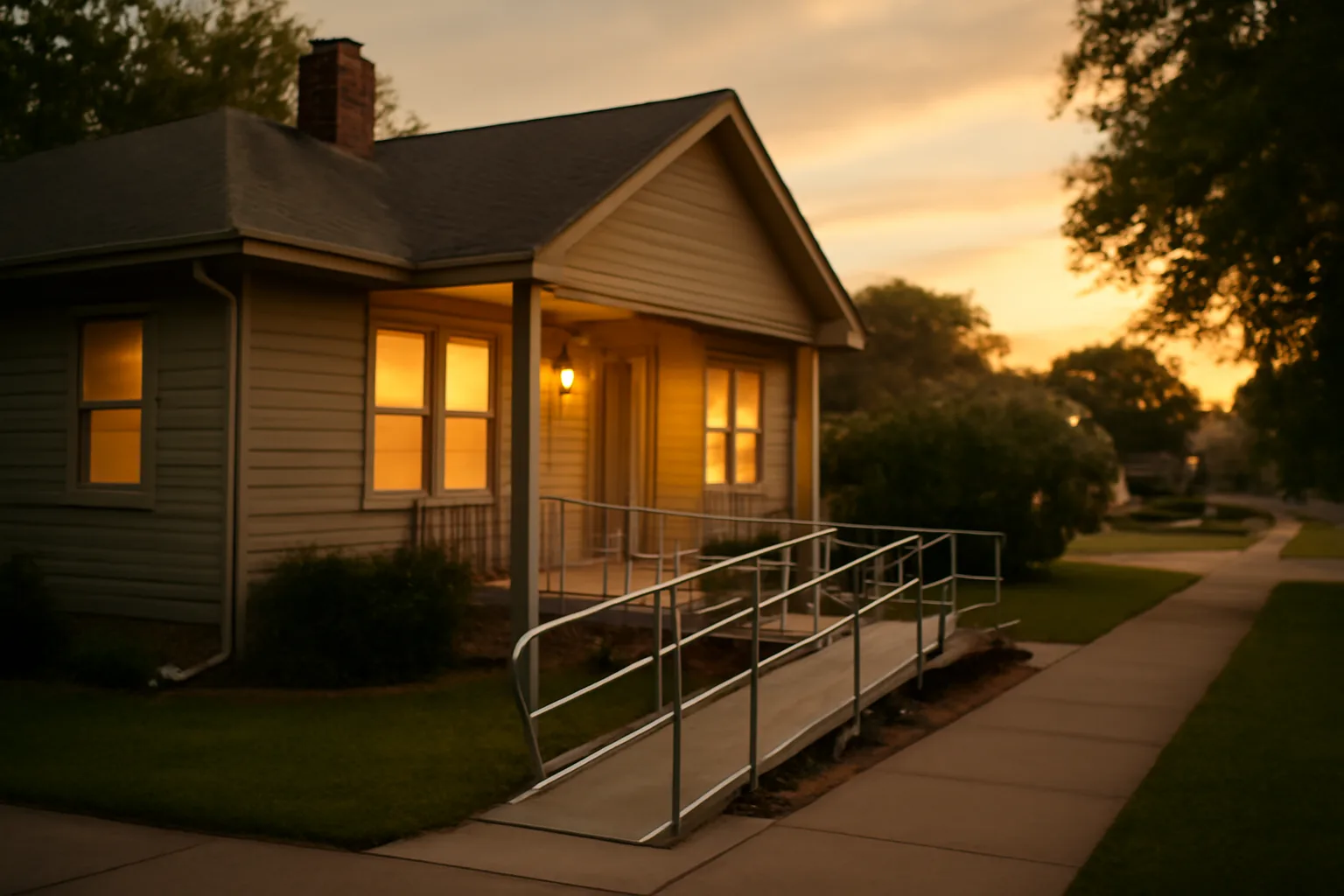
Assisted living is a category of licensed housing where residents live in a home-like setting and get help with daily activities, like bathing, dressing, medication reminders, and meals, but don't need the hospital-level, skilled nursing care that a nursing home provides. It sits in the middle of the care spectrum: more support than independent living, less clinical intensity than a nursing facility. In Texas, the legal term is "assisted living facility" (ALF), and it's defined in Texas Health and Safety Code Chapter 247 as an establishment that furnishes food, shelter, and personal care services to four or more people who aren't related to the owner, for longer than 24 hours. That four-or-more threshold matters a lot for small operators, because a three-bed home caring for unrelated adults may fall under different rules than a four-bed or larger one, and Texas has specific facility types (discussed below) built for smaller residential-scale operations [1]. The practical difference from a big commercial building: a small residential assisted living facility is usually a converted single-family house, licensed for somewhere between 3 and 16 residents, staffed around the clock, and run more like a home than an institution. That's the model most people mean when they say "24-hour care small residential assisted living facility."
What is a group home, and how is it different from assisted living?
"Group home" is a general term, not a specific Texas license category. People use it loosely to describe any small residential setting where a group of unrelated adults live together and receive support, whether that's for seniors, people with intellectual or developmental disabilities (IDD), or people in mental health or recovery housing. In Texas, the actual licenses differ by population. A home for seniors needing help with daily living is licensed as an Assisted Living Facility under HHSC [1]. A home for people with intellectual or developmental disabilities is typically licensed as a Home and Community-based Services (HCS) or Intermediate Care Facility for Individuals with an Intellectual Disability (ICF/IID) provider, regulated separately from ALF rules [2]. Recovery residences and sober living homes have their own voluntary certification track through the Texas Health and Human Services Commission's recognized certifying organizations, rather than a facility license in the same sense. So when someone searches "group home," they might actually need an assisted living facility license, an IDD provider enrollment, or a recovery housing certification, depending on who they plan to serve. Getting the population right before you pick a license category saves months of wasted paperwork.
What is an assisted living facility under Texas law?
Under Texas Health and Safety Code Section 247.002, an assisted living facility is defined as a facility that provides personal care services, administration of medication, and 24-hour supervision to four or more residents who are unrelated to the owner or operator, in a residential-style environment [1]. HHSC regulates ALFs under Title 26 of the Texas Administrative Code, Chapter 553. Texas breaks ALF licenses into types based on residents' needs and mobility: - Type A: residents are capable of evacuating the building without physical assistance and don't have significant medical needs requiring overnight staff awake at all times.
- Type B: residents need staff assistance to evacuate, may be non-ambulatory or need overnight physical help, and the facility must have an awake staff member on duty 24 hours a day.
- Type C (also called adult foster care in some contexts): a small home setting, generally limited to a small number of residents, often licensed under a slightly different staffing standard. Most small 24-hour homes serving seniors who need real overnight help end up licensed as Type B, precisely because Type B requires that awake, on-duty staffing model [3]. Confirm current type definitions and any subcategories with your state licensing agency, because HHSC periodically updates program rules under 26 TAC Chapter 553.
What does 24-hour assisted living actually provide?
A 24-hour assisted living facility provides a bed, meals, help with activities of daily living (bathing, dressing, toileting, mobility), medication administration or reminders, housekeeping, laundry, and supervision around the clock. It is not a medical facility. Staff are not required to be nurses in every shift, though facilities must have access to nursing oversight depending on license type. Texas rules require ALFs to have sufficient staff on duty to meet resident needs at all times, and Type B facilities specifically require an awake attendant on every shift, day and night [3]. That's the core distinction buyers and families need to understand: Type A homes can staff with someone asleep on-site during overnight hours (as long as residents can self-evacuate and don't need overnight physical assistance), while Type B homes cannot. Meals must meet nutritional standards, and facilities generally must offer three meals a day plus snacks, following a written dietary plan reviewed periodically. Medication administration requires a designated, trained staff member (often called a medication aide) unless licensed nurses handle it, and HHSC has specific training and registration requirements for medication aides under Texas Health and Safety Code Chapter 242, applied by reference to ALF staff [4].
What is the difference between assisted living and a nursing home?
| Governing Texas law | Health & Safety Code Ch. 247 | Health & Safety Code Ch. 242 | |
|---|---|---|---|
| Typical resident need | Help with ADLs, supervision | Skilled nursing, rehab, complex medical care | |
| Nursing staff required | Not RN on every shift (varies by type) | Licensed nurse on duty 24/7 | |
| Setting | Home-like, residential | Institutional, medical | |
| Medicaid coverage | Limited (STAR+PLUS waiver room/board rules vary) | Medicaid covers nursing facility care broadly | Families sometimes assume assisted living is "a lighter version" of a nursing home, and that's roughly right, but the legal and staffing lines are firm. If a resident's medical needs exceed what an ALF is licensed to provide, Texas rules require the facility to either get additional waivers or discharge/transfer the resident to an appropriate level of care. |
The core difference is medical intensity and staffing. Nursing homes (called nursing facilities in Texas) are licensed under Texas Health and Safety Code Chapter 242 and must have a registered nurse on duty and licensed nursing staff providing hands-on skilled care, wound care, IV therapy, and rehabilitation services around the clock [4]. Assisted living facilities under Chapter 247 provide personal care and supervision but are not required to have RNs on every shift and don't provide skilled nursing care as their primary service [1]. Here's a side-by-side comparison: | Feature | Assisted Living Facility (ALF) | Nursing Facility |
Does Medicare cover assisted living facilities?
No. Medicare does not pay for room and board or personal care in an assisted living facility. Medicare.gov states plainly that Medicare does not cover "long-term care" (also called custodial care) if that's the only care a person needs, and that includes most assisted living costs [5]. Medicare may cover short-term skilled nursing stays after a qualifying hospital stay, or medical services delivered while a person happens to live in an ALF (doctor visits, physical therapy, durable medical equipment), but it does not cover the facility's daily rate. Medicaid is a different story, but it's limited too. Texas Medicaid, through the STAR+PLUS program and the HCS/CFC waiver structures, can pay for personal attendant care and some services delivered in a residential setting, but it generally does not pay the room and board portion of an assisted living stay. CMS confirms that home and community-based services waivers can cover personal care and habilitation, while room and board remains the resident's responsibility in most cases [6]. This gap is one reason families ask about it constantly and one reason operators need a clear-eyed private-pay or waiver-based business model before opening. Confirm current STAR+PLUS and HCS waiver coverage rules with HHSC and CMS, since program rules and enrollment caps change.
How to start a group home (assisted living facility) in Texas
Starting a licensed 24-hour small residential assisted living facility in Texas follows a defined sequence, even though the paperwork feels dense the first time through. 1. Decide your population and license type. Confirm with HHSC whether your model fits Type A, Type B, or another ALF designation, or whether you actually need an IDD provider license instead [3]. 2. Check zoning and property fit. Confirm with your local city or county planning department that residential care use is allowed at your address, and check any occupancy or fire code requirements for the building size and resident count you plan. 3. Form your business entity and get a federal EIN, then register with the Texas Secretary of State if you're forming an LLC or corporation. 4. Complete required training. Texas requires the facility administrator to hold or obtain the appropriate license or training, and HHSC publishes administrator qualification rules under 26 TAC Chapter 553 [3]. 5. Submit the ALF license application to HHSC, including facility floor plans, fire marshal inspection approval, policies and procedures manual, staffing plan, and application fee. Confirm current fee amounts with HHSC, since license fees are set by rule and updated periodically. 6. Pass your life safety and fire marshal inspection, plus the HHSC pre-licensure survey of the physical building and your written policies. 7. Hire and train staff according to your license type's staffing ratios, including medication aide certification where required. 8. Receive your license and open, then prepare for the first annual survey, which typically happens within the first year and then on a recurring cycle. HHSC's Long Term Care Regulation division processes ALF applications and publishes the current application forms and instructions online; always work from their live checklist rather than a static list, since document requirements get updated [3].
How do I start a group home if I've never operated a facility before?
If you have zero facility experience, the honest advice is to spend real time in the industry before you sign a lease. Work or volunteer in an existing ALF for a few months if you can. Shadow an administrator through an inspection. Read the actual rule text in 26 TAC Chapter 553, more than a summary, because HHSC surveyors cite the rule, not a paraphrase of it. From there, the mechanical steps are the same as above, but first-time operators typically underestimate three things: cash reserves for the months between lease signing and first paying resident, the time it takes to recruit and retain awake overnight staff, and the detail required in a policies and procedures manual that will actually survive an HHSC survey. A lot of first-timers try to write their P&P manual from a generic template found online, and surveyors catch it immediately because it doesn't match their specific building, staffing plan, or state citations. Building your manual around the specific Texas statute and rule numbers that apply to your license type is what actually holds up. This is the exact gap the $299 State Group Home Licensing Kit is built to close: state-specific application checklists and policy manual templates mapped to your state's rule numbers, so you're not guessing which citations belong in your paperwork.
What staffing does a small 24-hour ALF need in Texas?
Staffing requirements depend on license type and resident acuity, but a few things are consistent. Type B facilities must have an awake attendant on duty 24 hours a day, every day, because residents may need overnight physical assistance or can't self-evacuate [3]. Type A facilities may allow a staff member to sleep on-site overnight if residents are capable of self-preservation in an emergency, though many small operators choose to staff awake overnight regardless, since it reduces liability and improves care quality. Medication aides must complete a state-approved training program and registration under Texas Health and Safety Code Chapter 242, applied to ALF staff who administer medications [4]. Facility administrators must meet HHSC qualification standards, which generally include a combination of education, experience, and a state administrator training course, verified at license application. Staff-to-resident ratios aren't set as a single fixed number across all of Texas ALF rule; instead, the rule requires "sufficient staff" to meet residents' documented needs, which HHSC surveyors evaluate against each resident's individual service plan. That means a home with several residents who need two-person transfers needs more staff on shift than a home with the same headcount of mostly independent residents. Confirm current staffing rule language and any recent updates with HHSC before finalizing your staffing plan.
What does the Texas ALF inspection process look like?
Before licensure, HHSC conducts an initial survey of the physical building, checking life safety compliance (often coordinated with your local fire marshal), resident living space requirements, kitchen and food service sanitation, and your written policies and procedures. This happens after your application is deemed complete and before your license is issued. Once licensed, ALFs go through regular unannounced surveys, typically on an annual cycle, plus complaint-based investigations if HHSC receives a report. Surveyors check resident records, medication administration logs, staffing schedules against actual coverage, emergency preparedness plans, and physical plant conditions. Deficiencies get cited by rule number, and facilities must submit a plan of correction with a timeline. Small residential-scale ALFs face the same survey rigor as larger buildings, just applied to a smaller footprint. A three-bedroom home with three residents gets the same records review and life safety scrutiny as a 16-bed facility; the paperwork burden doesn't scale down proportionally with resident count, which surprises a lot of first-time small-home operators.
How much does it cost and how long does licensing take?
Costs vary by license type, building size, and whether you're leasing or buying, so treat any number here as a planning range, not a quote. Application fees for Texas ALF licenses are set by HHSC rule and should be confirmed directly with the agency, since fee schedules are updated periodically under 26 TAC Chapter 553 [3]. Beyond the state fee, expect real costs for fire marshal inspection compliance (sprinkler or alarm upgrades in older homes can run into the tens of thousands of dollars), staffing before you have paying residents, liability insurance, and background check processing for every staff member. Timeline from application submission to open license is commonly 3 to 6 months for a small home, assuming the building already meets residential fire and building code for the resident count and there are no major life safety corrections needed. Homes that need sprinkler retrofits or significant renovation can take considerably longer, sometimes 9 to 12 months, because construction and re-inspection cycles add time on top of the licensing review itself. Build slack into your timeline. HHSC application review isn't instantaneous, and incomplete applications get returned for correction, which restarts part of the clock.
What zoning issues catch small ALF operators off guard?
Zoning is the most common reason a promising small-home project stalls before it ever reaches HHSC. Local zoning codes vary by city and county, and "residential care facility" or "group home" uses are sometimes restricted to certain zoning districts, subject to conditional use permits, or capped by resident count under local ordinance, separate from state licensing rules. Federal fair housing law does provide some protection: the Fair Housing Act generally prohibits municipalities from using zoning to exclude group homes for people with disabilities in ways that treat them differently from other residential uses, and HUD has published guidance on how zoning restrictions can violate the Act when applied to group homes for people with disabilities . That said, fair housing protections are complicated, fact-specific, and not a substitute for actually checking local zoning before you sign a lease. Before you commit to a property, confirm with your city or county planning department, in writing if possible, that residential care use at your specific resident count is allowed by right or by permit at that address. Doing this after you've already signed a lease is one of the most expensive mistakes a first-time operator can make.
Frequently asked questions
What is assisted living in simple terms?
Assisted living is housing for adults who need help with daily activities like bathing, dressing, and medication, but not full-time medical or nursing care. It combines a private or shared living space with staff support, meals, and supervision, usually in a home-like setting rather than a hospital-style building.
What is a group home exactly?
A group home is a general term for a small residential setting where unrelated people live together and receive support, whether for seniors, people with disabilities, or those in recovery. The specific license required in Texas depends on the population served: assisted living, IDD provider, or recovery residence certification are all different tracks.
What is an assisted living facility license in Texas?
It's a license issued by the Texas Health and Human Services Commission under Health and Safety Code Chapter 247, authorizing a facility to provide food, shelter, personal care, and supervision to four or more unrelated residents for more than 24 hours. Facilities are typed as A, B, or other categories based on residents' evacuation ability and care needs.
What is assisted living vs nursing home care?
Assisted living provides help with daily activities and supervision without requiring a nurse on every shift; nursing homes provide skilled medical and nursing care with a licensed nurse on duty 24/7, governed in Texas by a separate statute, Chapter 242 of the Health and Safety Code, versus Chapter 247 for assisted living.
What does assisted living provide day to day?
Assisted living provides meals, help with bathing and dressing, medication administration or reminders, housekeeping and laundry, social activities, and 24-hour supervision. It does not typically include skilled nursing procedures like wound care or IV therapy unless the facility has additional licensing or brings in outside home health services.
Does Medicare cover assisted living facilities in Texas?
No. Medicare.gov states Medicare does not cover long-term custodial care, which includes most assisted living room and board costs. Medicare may cover short-term skilled nursing after a hospital stay or specific medical services a resident receives while living in an ALF, but not the facility's daily rate.
How do I start a group home in Texas?
Confirm your population and license type with HHSC, check local zoning, form your business entity, complete administrator training, submit the ALF license application with floor plans and a policies manual, pass the fire marshal and HHSC survey, hire required staff, and then open once your license is issued.
How much does it cost to open a small assisted living home in Texas?
Costs vary widely by building condition and license type. Beyond the state application fee (confirm current amounts with HHSC), expect costs for fire and life safety upgrades, staffing before residents move in, insurance, and background checks. Older homes needing sprinkler retrofits can add tens of thousands of dollars.
How long does it take to get an assisted living license in Texas?
Commonly 3 to 6 months for a small home that already meets fire and building code requirements for its resident count. Homes needing significant renovation or sprinkler installation can take 9 to 12 months or longer, since construction and re-inspection cycles extend the timeline.
What is the difference between Type A and Type B assisted living in Texas?
Type A facilities serve residents who can evacuate without physical help and don't need overnight physical assistance, so overnight staff can be asleep on-site. Type B facilities serve residents who need help evacuating or overnight physical assistance, and Texas rule requires an awake attendant on duty 24 hours a day.
Can a small residential home serve fewer than four residents without a license?
Texas Health and Safety Code Chapter 247 defines an assisted living facility as serving four or more unrelated residents; homes with three or fewer may fall outside that specific licensing threshold, but local zoning, fire code, and other state rules can still apply. Confirm your specific situation with HHSC before assuming no license is needed.
Does Texas Medicaid pay for assisted living room and board?
Generally no. Texas Medicaid programs like STAR+PLUS can cover personal care and attendant services delivered in a residential setting, but room and board is typically the resident's own responsibility. Confirm current waiver rules and any exceptions directly with HHSC and CMS, since coverage details change.
What training does a medication aide need in a Texas assisted living facility?
Medication aides must complete a state-approved training program and registration process under standards tied to Texas Health and Safety Code Chapter 242, applied to ALF staff who administer medications. Facilities must keep proof of current registration on file for every staff member performing this role.
Sources
- Texas Health and Safety Code, Chapter 247: Definition of assisted living facility and the four-or-more resident threshold
- Texas HHSC, Home and Community-based Services (HCS) Program: IDD residential services are licensed separately from assisted living facilities
- Texas Administrative Code, Title 26, Chapter 553: ALF license types (A, B), staffing requirements, and administrator qualifications
- Texas Health and Safety Code, Chapter 242: Medication aide training and registration standards applied to facility staff
- Medicare.gov, Long-Term Care coverage: Medicare does not cover long-term custodial care such as most assisted living costs
- Medicaid.gov, Home & Community Based Services: Medicaid HCBS waivers can cover personal care but generally not room and board