Last updated 2026-07-25
TL;DR
An assisted living home license is a state-issued approval to operate housing plus personal care (meals, medication help, supervision) for adults, usually seniors. Every state licenses these differently, through health departments, aging agencies, or social services. Expect a written application, background checks, a physical plant inspection, a staffing plan, and fees that often run from a few hundred to several thousand dollars depending on capacity.
What is assisted living?
Assisted living is a licensed residential setting that combines housing with personal care services like bathing, dressing, medication reminders, and meal prep, for people who need help with daily life but don't need round-the-clock skilled nursing. It sits between independent living and a nursing home on the care spectrum. The federal government doesn't define or license assisted living directly. States regulate it individually, which is why the rules, terminology, and even the name of the license vary so much [1]. Some states call it a "residential care facility," others "personal care home," "adult foster care," or "assisted living facility." The functions overlap heavily even when the label doesn't match. Because there's no single national assisted living statute, the honest starting point for any operator is your own state licensing agency, not a national database. If you're comparing definitions across states, our assisted living overview breaks down how the terminology shifts state to state.
What is a group home?
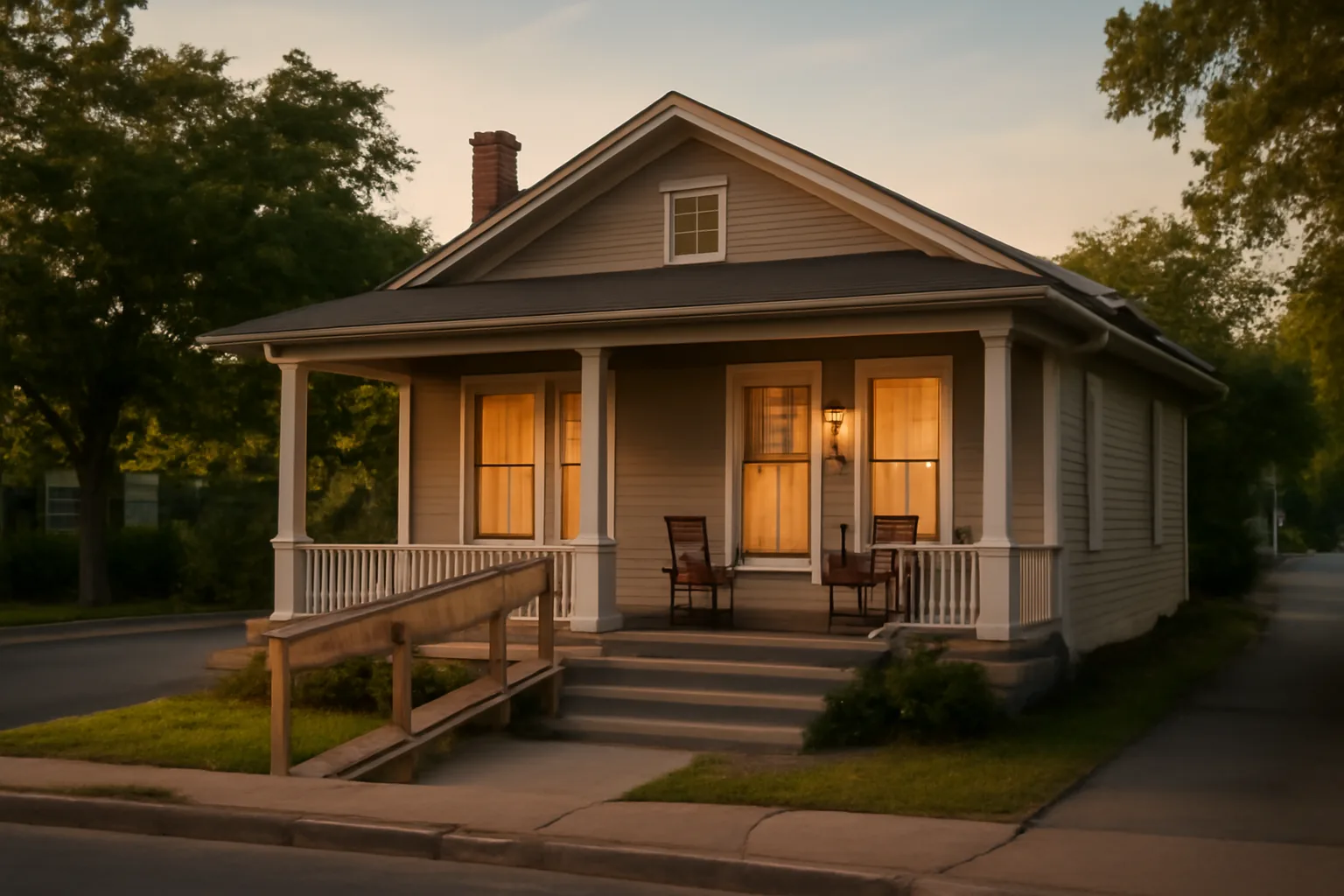
A group home is a small residential setting, usually a single-family style house, where a limited number of unrelated adults live together and receive supervision, support, or care from paid staff. The term covers a lot of ground: group homes serve people with intellectual and developmental disabilities (IDD), people in mental health or substance use recovery, and seniors who need assisted-living-level support. The regulatory line between "group home" and "assisted living facility" is mostly about population and scale, not physical design. A six-bed adult foster care home for seniors and a six-bed IDD group home might look identical from the curb but answer to completely different licensing chapters, staffing ratios, and inspection checklists in the same state. If you're trying to figure out which category your project falls into, that decision usually happens before you file any paperwork, because it determines which state division reviews your application and which rulebook governs everything from staff training hours to fire code.
What is an assisted living facility?
An assisted living facility (ALF) is the licensed building or program itself, the physical plant plus the staff and services operating under a state license number. It's the legal entity name that shows up on your license certificate, more than a marketing term. Most states define an ALF by what it's allowed to provide: a private or semi-private room, meals, housekeeping, help with activities of daily living (ADLs), medication management or administration (states differ sharply on this), and 24-hour staff availability for supervision and emergencies. Capacity ranges widely, from small homes licensed for 3 to 8 residents up to large campuses licensed for 100-plus. States typically split ALF licenses by size or service level. Florida, for example, licenses assisted living facilities under Chapter 429 of its statutes, which requires licensure and sets out resident rights, admission criteria, and the agency's enforcement authority over facility operators [2]. Texas licenses assisted living facilities through the Health and Human Services Commission under Type A, Type B, and Type C designations based on residents' mobility and cognitive status [3]. Neither state's rules map cleanly onto the other, which is the core challenge of this business: you're not learning "assisted living licensing," you're learning your state's specific version of it.
What does assisted living provide, exactly?
Assisted living provides a private or shared living space combined with personal care services, meals, housekeeping, laundry, social activities, and staff supervision, but it stops short of the skilled nursing and rehabilitative therapy a nursing home is licensed to deliver. A typical assisted living service package includes: - Three meals a day plus snacks, often with dietary accommodation
- Help with ADLs: bathing, dressing, toileting, mobility, eating
- Medication management, ranging from reminders to administration depending on state rules and staff licensure
- Housekeeping and laundry
- 24-hour staff presence for supervision and emergency response
- Social and recreational programming
- Transportation to appointments (sometimes included, sometimes billed separately) What it does NOT typically include, unless the facility holds an additional specialty license, is ventilator care, IV therapy, wound care beyond basic first aid, or continuous skilled nursing oversight. Many states have a specific "nursing overlay" or "limited nursing services" endorsement that lets an ALF keep a resident whose needs have increased slightly, instead of forcing a move to a nursing home. Check whether your state offers that endorsement, since it changes both your staffing plan and your inspection scope.
What's the difference between assisted living and a nursing home?
| Licensing authority | State (varies by agency) | State + federal CMS conditions of participation | |
|---|---|---|---|
| Nursing staff | Often not required 24/7 | RN required 8+ hrs/day, licensed nurse 24/7 [4] | |
| Typical resident need | ADL help, supervision | Skilled nursing, rehab, complex medical care | |
| Medicare coverage of room/board | Not covered | Covered for limited post-hospital stays | |
| Setting | Apartment-style or house-style | Clinical, hospital-adjacent | This distinction also drives reimbursement. Medicaid can pay for personal care services in assisted living in many states through home and community-based services (HCBS) waivers, but nursing homes are covered under the regular Medicaid nursing facility benefit. The payment mechanisms are structurally different even when the resident population looks similar. |
Assisted living is for people who need help with daily activities but are medically stable; nursing homes (skilled nursing facilities) are for people who need ongoing medical care, rehabilitation, or complex clinical supervision from licensed nurses around the clock. The clearest way to see the difference is by staffing requirement. Nursing homes that participate in Medicare or Medicaid must meet federal conditions of participation, including having a registered nurse on duty at least 8 consecutive hours a day, 7 days a week, and licensed nursing coverage 24 hours a day, per the federal nursing home requirements at 42 CFR 483.35 [4]. Assisted living has no equivalent federal staffing floor. States set their own minimums, and many require only a licensed nurse consultant on a periodic, not continuous, basis. | Factor | Assisted living | Nursing home |
Does Medicare cover assisted living facilities?
No. Medicare does not cover the room and board cost of assisted living. Medicare.gov states plainly that Medicare "doesn't cover room and board when you get long-term care" or assisted living services, though it may still cover medically necessary items separately, like doctor visits, durable medical equipment, or a short-term skilled nursing stay after a qualifying hospitalization [5]. This catches a lot of new operators off guard when they're pricing out their business model. Medicare Part A can pay for up to 100 days of skilled nursing facility care after a qualifying 3-day inpatient hospital stay, with coinsurance kicking in after day 20, but that's nursing home care, not assisted living [6]. Assisted living residents typically pay privately, through long-term care insurance, or through state Medicaid HCBS waivers, which vary enormously in what they'll pay for and who qualifies. If your business plan for a residential care startup assumes Medicare will pay resident fees, stop and re-run the numbers. It won't. Medicaid HCBS waiver coverage of the service component (not room and board, which Medicaid also generally excludes) is the realistic public-payer path in most states, and waiver waitlists and reimbursement rates vary by state and by year, so confirm current rates with your state Medicaid agency before building a pro forma.
How to start a group home: the real sequence of steps
Starting a group home or assisted living home means working through licensing, property, staffing, and financing roughly in this order, though states vary on which piece has to come first. 1. Pick your population and license category. IDD, mental health, recovery, and senior assisted living each fall under different state chapters, staffing rules, and sometimes different state agencies entirely. This decision shapes everything downstream. 2. Contact your state licensing agency directly. Every state has a division (health department, aging services, or social/human services) that licenses residential care. Get the current application packet, fee schedule, and administrative code citation in writing, don't rely on secondhand summaries, including this one, for exact dollar figures. 3. Check zoning before you sign a lease or buy property. Many jurisdictions treat small group homes (typically 6 or fewer residents) as a protected residential use under the Fair Housing Act, which can preempt restrictive local zoning, but larger homes and specific overlay districts still need real due diligence. Our zoning and property guidance is a good next stop before you commit to an address. 4. Write your policy and procedure manual. States generally require written policies covering admission/discharge criteria, medication management, emergency and disaster planning, resident rights, abuse reporting, and staff training. This document gets reviewed line by line during licensing and again at every renewal inspection. 5. Build your staffing plan. Minimum staff-to-resident ratios, required certifications (CPR, first aid, medication aide training), background check requirements (state and often FBI fingerprint checks), and administrator qualifications are all set by your state's code, not by industry norms. 6. Pass your pre-licensure inspection. A state surveyor walks the physical plant against fire, safety, and life-safety code, checks your policy binder, and often interviews staff before issuing the license. 7. Apply for a provider number if you plan to bill Medicaid HCBS waiver services, through your state Medicaid agency, separate from your operating license. Budget real time for this. Some states process a complete assisted living application in 60 to 90 days; others take considerably longer if your file has gaps or your building needs corrections after the first inspection. Nobody should promise you a guaranteed timeline, and be skeptical of anyone who does.
How do I start a group home if I've never worked in senior care?
You don't need a nursing background to start a group home in most states, but you almost always need a qualified administrator, and many states require that person to hold a specific credential or pass a state administrator exam before the license is issued. Check your state's administrator requirements early, because they often take months to satisfy. Some states require an assisted living administrator license separate from the facility license, with continuing education hours renewed annually. If you're not going to be the hands-on administrator yourself, you'll need to hire or contract with someone who meets the requirement before your application can move forward. Operators coming from outside healthcare (people transitioning from real estate, business ownership, or caregiving for a family member) succeed at this more often when they treat the licensing process as its own project, with its own deadlines and checklist, rather than something to figure out after the building is ready. That's the gap our State Group Home Licensing Kit is built to close: a one-time $299 packet organized around your state's application requirements, policy manual templates, and inspection prep checklists, so you're not reconstructing the process from scratch or paying a consultant by the hour to explain what your state's own code already says.
What does the application and inspection process actually look like?
Most states use a similar sequence even though the paperwork looks different: submit a written application with your entity's legal formation documents, pay the licensing fee, submit floor plans and fire marshal sign-off, complete background checks for owners and key staff, submit your policy manual, and pass an on-site inspection before a license is issued. Fire and life-safety inspection is where first-time applicants most often stall. Group homes and assisted living buildings typically need to meet a specific occupancy classification under the state's adopted fire code (many states adopt NFPA 101, the Life Safety Code, with state-specific amendments), which affects everything from exit door hardware to sprinkler requirements to smoke detector placement. An existing single-family house often needs real retrofit work to meet this, so get the fire marshal's input before you buy or lease, not after. After initial licensure, expect ongoing inspections. Frequency varies by state and by any prior violation history, but annual or biennial surveys are common, plus complaint-driven inspections that can happen at any time. Keep your policy binder, staff training records, medication logs, and incident reports organized and current, because a surveyor will ask for them on the spot, not on a delay.
How much does an assisted living home license cost?
Licensing fees vary by state and often scale with bed capacity, but expect a range from a few hundred dollars for a small home up to several thousand dollars for a large facility, plus separate costs for background checks, fire inspections, and any required administrator certification exam. Florida law directs its Agency for Health Care Administration to set assisted living facility license fees under Chapter 429, and those fees scale with resident capacity and license type, so a small facility and a 100-plus bed facility pay very different amounts [2]. That's typical of how states structure fees: it's rarely a flat number, and renewal fees are usually lower than the initial application fee. On top of the state fee, budget for background check processing fees (state and FBI fingerprinting), any local business license or fire permit fees, and the cost of physical plant corrections identified during your first walkthrough. The number you actually need is the current fee schedule published by your state licensing agency this year, not a figure from an old blog post or a competitor's site. Fee schedules get revised, sometimes annually, so pull the current PDF or fee page directly from the agency before you build your budget.
What staffing and training does an assisted living license require?
States generally require a licensed administrator, a minimum direct-care staff-to-resident ratio (often stricter overnight versus daytime), completed background checks for anyone with resident contact, and documented initial and ongoing training in topics like medication assistance, abuse reporting, first aid/CPR, and fire safety. Training hour requirements differ sharply by state and by role. Some states specify a set number of initial orientation hours (commonly in the 8 to 40 hour range depending on state and position) plus annual continuing education hours for direct care staff, with additional hours for medication aides. Administrators typically face a higher bar: a state exam, a minimum number of college credit hours or equivalent healthcare experience, and ongoing continuing education to keep the credential current. Don't guess on ratios. A facility licensed for 16 residents and a facility licensed for 60 residents in the same state can have very different minimum staffing formulas, and getting caught understaffed during an inspection is one of the fastest ways to get a corrective action plan or a license held up at renewal.
What should I read before I apply?
Before you file anything, pull three documents directly from your state licensing agency's website: the current assisted living or residential care licensing statute/administrative code chapter, the fee schedule, and the inspection or survey checklist your state's surveyors actually use. These are usually public documents, and they tell you exactly what's being graded. It's also worth reading your state's most recent public enforcement actions or survey results if the agency publishes them. Seeing the actual violations that get cited (short staffing, missed medication logs, expired fire extinguisher tags, incomplete resident files) is a faster education than any generic checklist, because it shows you what surveyors in your state actually flag in practice. If you're weighing assisted living against a different residential care category (IDD group home, adult foster care, recovery residence), compare the license types side by side before committing to a property or a lease, since converting a building from one license category to another mid-project usually means redoing parts of the application. Our assisted living facility and assisted living facilities guides walk through how states differentiate these categories in more detail, and our senior assisted living facilities near me piece is useful if you're researching the competitive landscape in your target market before you file.
Frequently asked questions
What is assisted living?
Assisted living is a licensed residential option combining housing with personal care services like bathing, dressing, medication reminders, and meals, for adults who need daily support but not continuous skilled nursing. States, not the federal government, regulate and define assisted living, so exact rules and terminology vary by state [1].
What is a group home?
A group home is a small residential setting, typically a house, where a limited number of unrelated adults live together and receive staff supervision or support. Group homes serve different populations, including people with intellectual/developmental disabilities, mental health or recovery residents, and seniors, each under different state licensing rules.
What is an assisted living facility?
An assisted living facility is the licensed building and program providing housing plus personal care, meals, and supervision to residents, operating under a state-issued license number. States like Florida and Texas license these under their own statutes with distinct capacity tiers and service-level designations [2][3].
What is the difference between assisted living and a nursing home?
Assisted living serves people who need help with daily activities but are medically stable; nursing homes serve people needing ongoing skilled nursing or rehabilitation. Federally certified nursing homes must have an RN on duty at least 8 hours daily and licensed nursing coverage 24/7; assisted living has no equivalent federal staffing mandate [4].
Does Medicare cover assisted living facilities?
No. Medicare does not pay for assisted living room and board or the personal care services themselves. Medicare.gov confirms it "doesn't cover... room and board" for long-term care or assisted living, though it may cover separate medical services received while living there, like doctor visits or short-term skilled nursing after a hospital stay [5].
How do I start a group home?
Pick your population and license category, contact your state licensing agency for the current application and fee schedule, confirm zoning before signing a lease, write your required policy manual, build a compliant staffing plan, and pass the pre-licensure inspection. Each state sequences these steps a little differently, so get your state's checklist first.
How much does it cost to get an assisted living license?
Costs vary widely by state and scale with bed capacity, ranging from a few hundred dollars for small homes to several thousand for larger facilities, plus separate background check and fire inspection fees. Florida's fee schedule, for example, scales by facility size and license type under Chapter 429 of its statutes [2].
What's the difference between an assisted living facility and a nursing home for licensing purposes?
Assisted living is licensed at the state level only, often under health or social services codes, while nursing homes must also meet federal Medicare/Medicaid conditions of participation enforced by CMS, including specific nursing staffing hours and clinical documentation standards not required in most assisted living regulations [4].
Do I need medical or nursing experience to open a group home?
Not necessarily as the owner, but most states require a licensed or certified administrator overseeing daily operations, and that person often must pass a state exam or meet minimum experience/education requirements. If you're not filling that role yourself, you'll need to hire someone who meets your state's administrator credential before licensing can proceed.
How long does it take to get an assisted living home license?
Timelines vary by state and by how complete your application and building are on first submission; some states process straightforward applications in roughly 60 to 90 days, while others take longer, especially if the fire marshal requires physical plant corrections. Confirm current processing timelines with your state licensing agency directly.
Can Medicaid pay for assisted living instead of Medicare?
In many states, yes, through Medicaid Home and Community-Based Services (HCBS) waivers that cover personal care and supportive services in assisted living settings, though room and board is typically excluded and waiver availability, waitlists, and reimbursement rates vary by state. Confirm current waiver rules with your state Medicaid agency.
What size home counts as a group home versus a full assisted living facility?
There's no single national threshold; states set their own capacity tiers, and many draw distinctions around 6, 8, 16, or higher resident counts that trigger different staffing ratios, fire code requirements, and license subtypes. Some states also use smaller size categories to qualify for Fair Housing Act protections against restrictive local zoning.
What kind of inspection happens before an assisted living license is issued?
A state surveyor typically inspects the physical building against fire and life-safety code, reviews your written policies (admission/discharge, medication management, emergency planning, resident rights), and may interview staff, before the initial license is issued. Ongoing inspections, often annual or biennial, continue after licensure.
Sources
- 42 CFR Part 483, Subpart B (state licensing of long-term care, general framework): Assisted living is regulated by the state, not the federal government
- Florida Statutes, Chapter 429, Part I, Assisted Living Facilities: Florida licenses assisted living facilities under Chapter 429 and sets licensure, fee, and enforcement authority
- Texas HHSC, Assisted Living Facilities: Texas licenses assisted living facilities under Type A, Type B, and Type C designations
- 42 CFR 483.35, Nursing services: Federally certified nursing homes must have an RN on duty at least 8 consecutive hours daily and licensed nursing coverage 24/7
- Medicare.gov, Long-term care: Medicare doesn't cover room and board for assisted living or long-term care
- Medicare.gov, Skilled nursing facility care: Medicare Part A covers up to 100 days of skilled nursing facility care after a qualifying 3-day hospital stay, with coinsurance after day 20