Last updated 2026-07-26
TL;DR
Assisted living facilities are typically larger, state-licensed communities with apartment-style units and a full activities calendar. Residential care homes (often called group homes or adult foster care) are smaller, house-based settings, usually 2 to 10 residents, with more of a family feel. Both are non-medical; neither is covered by Medicare room and board, though Medicaid waivers may help in some states [1][2].
What is assisted living?
Assisted living is a licensed, non-medical residential option for people who need help with daily activities like bathing, dressing, medication reminders, and meals, but who don't need the round-the-clock skilled nursing care a nursing home provides. Most states license these as "assisted living facilities" or "assisted living residences," and the rules live in each state's health or social services code rather than in one federal law. The National Center for Health Statistics, using the National Study of Long-Term Care Providers, counted roughly 28,900 residential care communities in the United States with about 1.2 million licensed beds [1]. That number covers small homes and large campuses with 100-plus units alike, because "assisted living" isn't one uniform building type. It's a licensing category, and every state draws its own lines on minimum staffing, room size, and what level of care a resident can have before they must move to a nursing facility. Most assisted living residents pay privately or through long-term care insurance. Medicaid does not pay for assisted living room and board in most states, though many states run a Medicaid Home and Community-Based Services (HCBS) waiver that can cover some of the care costs inside an assisted living setting [2]. Room and board itself almost always stays the resident's responsibility. If you're researching this because you're comparing settings for a family member, start with your state's assisted living facility licensing directory, which usually lists every licensed provider, their capacity, and any recent inspection findings.
What is a group home?
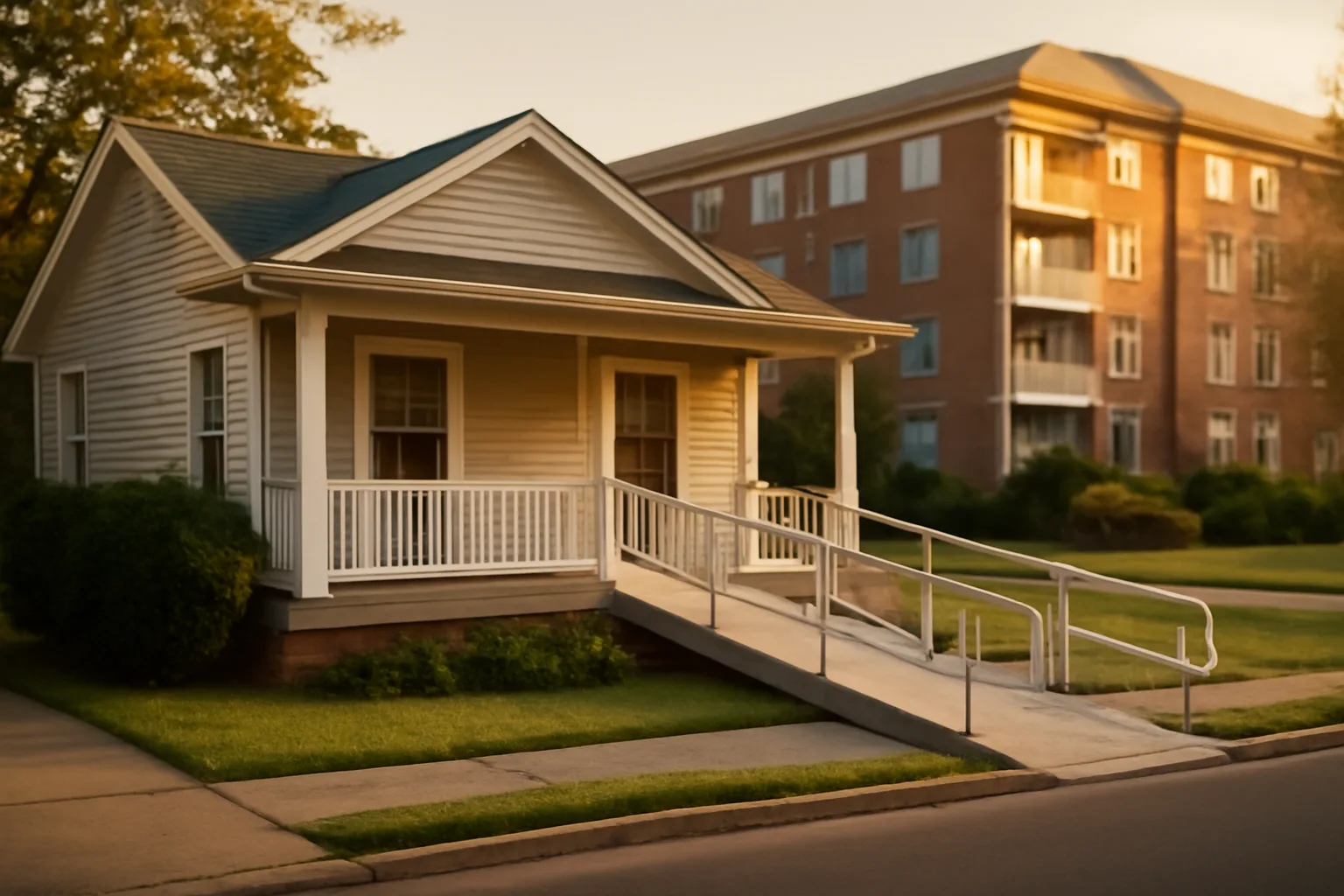
A group home is a small, licensed residential setting, usually in a regular single-family house, where a small number of people (commonly 2 to 10, though the cap varies a lot by state) live together and receive support with daily living. The term covers several different populations under state law: adults with intellectual or developmental disabilities (IDD), people in mental health recovery, and in some states, seniors who need a smaller, home-like alternative to a big assisted living building. Group homes are licensed differently depending on the population served. An IDD group home might be licensed under a state's developmental disabilities agency, while a mental health group home falls under behavioral health licensing, and a senior-focused adult foster care home falls under aging services or public health. This is exactly why "group home" and "assisted living facility" get confused: they can look almost identical from the curb, a converted house on a residential street, but the license, the funding source, and the resident population differ. Because group homes are small, staffing ratios tend to be tighter (fewer residents per direct care worker) and the environment feels more like a family household than an institution. That's the appeal for many families and for many operators too: lower buildout and staffing costs than a large assisted living community, though also lower total bed capacity. If you're weighing whether to license as a small group home or a larger assisted living operation, run the numbers on your state's specific staffing ratio and physical plant rules before you commit to a property. Zoning matters here too. Group homes serving people with disabilities are often protected under the Fair Housing Act as a reasonable accommodation in single-family zones, which is not automatically true for large assisted living buildings that function more like commercial care facilities.
What is an assisted living facility (and what does it actually provide)?
An assisted living facility is the licensed building or program itself, the physical location and the legal entity that holds the state license to provide personal care services to residents who live there. "Assisted living facility" and "assisted living" get used interchangeably, but the facility is the licensed operation; assisted living is the level of care model. What does assisted living provide, in practical terms? Typically: a private or semi-private room or apartment, three meals a day, help with activities of daily living (bathing, dressing, toileting, mobility), medication management or reminders, housekeeping and laundry, 24-hour staff presence, and a social or activities program. Some facilities also offer memory care units for residents with dementia, though that's usually a distinct license tier or added certification in most states, not a default feature. What assisted living does not typically provide: skilled nursing care, IV therapy, ventilator support, or the kind of medical monitoring a hospital or nursing facility gives. If a resident's care needs escalate past what the facility is licensed to provide, most states require a "negotiated risk agreement" or an involuntary discharge process, and the resident typically has to move to a nursing facility. For a full state-by-state breakdown of what license categories exist and what paperwork they require, see assisted living facilities and facility assisted living licensing overviews.
Assisted living vs residential care home: what's actually different?
| Typical size | 20 to 120+ residents | 2 to 10 residents (varies by state) | |
|---|---|---|---|
| Setting | Purpose-built building, apartment-style units | Converted single-family house | |
| Staff ratio | Lower staff-to-resident ratio, shift-based | Often higher ratio, smaller staff team | |
| License authority | State health department, aging or social services agency | Varies: aging services, DD agency, or behavioral health, depending on population | |
| Zoning | Often commercial or institutional zoning | Often residential zoning, sometimes fair-housing protected | |
| Typical funding | Private pay, long-term care insurance, some Medicaid waiver for care (not room/board) | Private pay, SSI, Medicaid waiver in some states, adult foster care stipends | |
| Feel | Community/campus, more amenities | Family-style household | The honest answer to "which is better" is: it depends on the resident's needs and preferences, and on what's actually licensed and inspected well in your area. A resident who wants an active social calendar, dining room, and organized outings usually does better in a larger assisted living community. A resident who gets overwhelmed by big groups, or who needs a very high staff-to-resident ratio because of behavioral or cognitive needs, often does better in a small group home setting. |
The two terms often describe the same regulatory idea (non-medical, licensed residential care) but at different scale and, sometimes, under different state statutes entirely. Some states literally use "residential care home" as their legal license name for what other states call "assisted living." Others use "residential care home" specifically for the smaller, house-based version and reserve "assisted living facility" for larger buildings with more services. Confirm with your state licensing agency which term applies, because this varies enormously and there is no single federal definition. | Feature | Assisted living facility | Residential care home / group home |
What is the difference between assisted living and a nursing home?
Assisted living is non-medical personal care; a nursing home (also called a skilled nursing facility) provides medical and rehabilitative care under the supervision of licensed nurses and, often, on-site physicians. Nursing homes are certified under federal Medicare and Medicaid rules (42 CFR Part 483) and must meet specific staffing and clinical requirements that assisted living facilities do not [3]. CMS requires nursing homes to have a registered nurse on site at least 8 consecutive hours a day, 7 days a week, and licensed nursing staff available 24 hours a day [3]. Assisted living facilities have no equivalent federal staffing mandate; state rules vary widely, and many only require a licensed nurse be "available" or on call rather than on-site around the clock. Cost differs sharply too. Genworth's Cost of Care Survey (a commonly cited industry benchmark, last published in 2021 with projections since) put the median monthly cost of assisted living at roughly $4,500 and a semi-private nursing home room at roughly $7,908 to $7,900 per month nationally, though these figures shift by state and year and should be confirmed against current local data [4]. The bigger structural difference is what pays for it: nursing home stays are far more likely to be covered by Medicare (short-term, post-hospital only) or Medicaid (long-term, if the resident qualifies financially), while assisted living almost never gets Medicare coverage and gets Medicaid help only through specific state waiver programs [2][5].
Does Medicare cover assisted living facilities?
No. Medicare does not cover the cost of room and board or personal care at an assisted living facility. Medicare.gov states plainly that Medicare "doesn't cover room and board" for long-term care, and that assisted living falls under long-term services and supports, which Medicare generally does not pay for [5]. Medicare will sometimes cover specific medical services delivered to someone who happens to live in assisted living, things like doctor visits, physical therapy, or durable medical equipment under Medicare Part B, but that's a coverage of the medical service, not the housing or personal care itself [5]. Medicaid is a different story, and this is where the real funding nuance lives. Medicaid does not pay for room and board in assisted living in most states either, but many states operate a Medicaid Home and Community-Based Services (HCBS) waiver under Section 1915(c) of the Social Security Act that can pay for personal care, case management, and other services delivered inside an assisted living or residential care setting [2]. Eligibility, waiting lists, and covered services vary enormously by state, so anyone counting on Medicaid to help with assisted living costs needs to check their specific state Medicaid agency's waiver program, not assume blanket coverage. For group homes serving Medicaid-eligible populations (IDD, mental health), HCBS waivers are often the primary funding mechanism rather than a supplement, which is a meaningful difference from how most private-pay assisted living operates.
How do I start a group home? (step-by-step overview)
Starting a group home means getting a state license before you can legally accept residents, and the process runs through several stages that every state requires in some form, even though the specific agency names and fee amounts differ. 1. Pick your population and license category. Decide whether you're licensing for seniors (adult foster care / residential care), adults with intellectual or developmental disabilities, mental health recovery, or another category. Each has a different licensing agency and rulebook; confirm with your state licensing agency which department handles your specific population. 2. Check zoning before you sign a lease or purchase. Many group homes for people with disabilities are protected under the federal Fair Housing Act (42 U.S.C. § 3604) as a reasonable accommodation in single-family residential zones, but local occupancy limits, fire code, and business license rules still apply, and you need to confirm this with your local planning or zoning department directly [6]. 3. Meet the physical plant requirements. Fire safety, egress, bedroom square footage per resident, number of bathrooms, and sometimes sprinkler requirements are set by your state's licensing code and sometimes by the local fire marshal. This is one of the most common reasons applications stall. 4. Write your policy and procedure manual. States typically require written policies on medication management, resident rights, emergency and disaster planning, abuse reporting, staff training, and grievance procedures before they'll issue a license. 5. Build your staffing plan. You'll need to show minimum staff-to-resident ratios (set by your state), background check completion for every staff member, and a training plan covering topics like CPR/first aid, medication administration, and abuse/neglect reporting. 6. Submit your application and pass inspection. Most states require a pre-licensing inspection of the physical building plus a review of your policy manual and staffing plan before issuing the initial license. Expect a state surveyor to walk the entire home, check resident files (once you have residents, or sample files during pre-licensure), and verify staff records. 7. Get your license and set up ongoing compliance. Most states require annual or biennial renewal, plus unannounced inspections, incident reporting, and continuing education for staff. This is the exact process a documented, state-specific checklist can save you from re-researching from scratch. GroupHomePath's $299 one-time State Group Home Licensing Kit builds out these steps (agency contacts, required forms, sample policy language, staffing ratio worksheets) for your specific state and population; you can start building yours at /licensing-kit-builder.
How do I start a group home if I've never worked in senior care or disability services before?
You don't need to be a nurse or a social worker to license a group home, but most states do require either a designated administrator with specific training/certification, or a licensed clinical staff member (depending on population), plus documented experience or education requirements for whoever runs daily operations. Requirements range from a short state-approved administrator course to a bachelor's degree in a health or human services field, depending on the state and the population served. Realistically, plan for three cost centers before you apply: the property (purchase or lease that meets zoning and fire code), the licensing and administrator training fees (these vary by state, often in the low hundreds to low thousands of dollars range, and you should confirm exact current fees with your state licensing agency), and working capital to cover payroll and utilities before you have a full census of paying residents. Many first-time operators underestimate the timeline. Between zoning confirmation, property prep, staff hiring and background checks, and the state's own review queue, a realistic timeline from "decided to do this" to "licensed and accepting residents" often runs several months to over a year, depending on your state's application backlog and whether your building needs renovation to meet fire and life-safety code.
What should families ask when comparing assisted living vs a residential care home?
Ask about the staff-to-resident ratio on the overnight shift specifically, more than the daytime number, since overnight staffing is where many facilities cut corners and where falls and medical emergencies are most dangerous. Ask what the facility's discharge policy is: at what point does declining health or behavior mean a resident has to leave, and where would they go? Ask to see the facility's most recent state inspection report. Every licensed assisted living facility and group home has a survey history, and most states publish these online or make them available on request; a facility that's cagey about sharing this is a red flag. Ask specifically about medication management: who administers medications, what training do they have, and what happens if a dose is missed or an error occurs? Ask about cost transparency: what's included in the base rate, and what triggers an additional "level of care" charge? Assisted living pricing is notorious for tiered add-on fees that can double the advertised base rate once a resident needs more help with mobility or incontinence care. Finally, ask how the facility handles a resident's transition if their needs exceed what's licensed there, since both assisted living and residential care homes have a ceiling on the acuity of care they're allowed to provide.
What does the licensing paperwork actually look like for each option?
For a larger assisted living facility, expect a licensing application packet that includes: a facility floor plan, fire marshal approval, a disclosure statement (resident rights, services offered, fee schedule), staffing plan with position descriptions, an admission/discharge policy, an emergency preparedness plan, and background check clearances for all staff and often the administrator's proof of required training or certification. For a smaller residential care home or group home, the packet is similar in substance but scaled to the smaller building: floor plan and fire inspection, a policy and procedure manual covering medication management and resident rights, staffing plan showing the ratio you'll maintain, background checks, and often a specific program plan if you're serving IDD or mental health populations under a Medicaid waiver contract. Both require ongoing renewal paperwork, usually annual, and both are subject to unannounced inspections where surveyors check resident records, medication logs, staff training files, and the physical condition of the building. The paperwork burden is genuinely similar in kind between a 6-bed group home and a 60-bed assisted living facility; it's just the scale (number of staff files, number of resident charts) that differs. If you're building this packet for the first time, working from a assisted living state licensing guide or a population-specific assisted living at home resource can save real time compared to starting from your state's raw regulatory text, which is often written in dense legal language without a practical checklist attached.
Frequently asked questions
What is assisted living in simple terms?
Assisted living is a licensed, non-medical residential setting where residents get help with daily activities like bathing, dressing, and medication reminders, plus meals and housekeeping, without the round-the-clock skilled nursing care a nursing home provides.
What is a group home?
A group home is a small, licensed residential setting, usually a house, where a small number of residents (often 2 to 10) live together and get support with daily living. Licensing depends on the population served: IDD, mental health, or senior care, each under a different state agency.
What is an assisted living facility?
An assisted living facility is the licensed building and legal entity providing assisted living services, personal care, meals, medication management, and 24-hour staff presence, without providing skilled nursing or medical care.
What is the difference between assisted living and a nursing home?
Assisted living is non-medical personal care with no federal staffing mandate; nursing homes are federally certified under 42 CFR Part 483 and must have a registered nurse on site at least 8 hours a day, 7 days a week, per CMS requirements.
Does Medicare cover assisted living facilities?
No. Medicare.gov states Medicare doesn't cover room and board for long-term care settings like assisted living. Medicare may cover specific medical services (doctor visits, therapy) delivered to a resident there, but not the housing or personal care itself.
Does Medicaid pay for assisted living?
Generally not for room and board, but many states run a Medicaid HCBS waiver under Section 1915(c) that can cover personal care and support services delivered inside an assisted living or residential care setting. Coverage and waiting lists vary by state; confirm with your state Medicaid agency.
How do I start a group home?
Pick your population and license category, confirm zoning, meet fire and physical plant code, write required policies (medication management, resident rights, emergency plans), build a staffing plan with background checks, then submit your application and pass a pre-licensing inspection through your state's licensing agency.
How much does it cost to start a group home?
Costs vary enormously by state and population served: property acquisition or lease, licensing and administrator training fees (often low hundreds to low thousands of dollars), renovation to meet fire code, and working capital before you reach full occupancy. Confirm current fee schedules with your state licensing agency.
Is a residential care home the same as assisted living?
Sometimes yes, legally; some states use "residential care home" as their official license term for what other states call assisted living. In other states, it refers specifically to smaller, house-based settings distinct from larger assisted living buildings. Confirm the term your state uses.
What does assisted living provide that a group home doesn't, or vice versa?
Assisted living typically offers more amenities (dining rooms, organized activities, larger campuses); group homes offer smaller households, often tighter staff-to-resident ratios, and are more likely to serve IDD or mental health populations through Medicaid waiver funding rather than private pay.
Can a group home be located in a residential neighborhood?
Often yes. Group homes serving people with disabilities are commonly protected under the federal Fair Housing Act (42 U.S.C. § 3604) as a reasonable accommodation in single-family zones, though local occupancy limits and fire code still apply. Confirm with your local zoning department.
What's the difference between assisted living and independent living?
Independent living is housing for seniors who don't need daily personal care assistance; it's not licensed as a care facility in most states. Assisted living is licensed specifically because it provides help with activities of daily living and often medication management.
Who regulates assisted living facilities and group homes?
Each state's health department, aging services agency, or developmental disabilities/behavioral health agency licenses and inspects these facilities, depending on the population served. There is no single federal licensing agency; requirements and terminology differ state by state.
Sources
- Medicaid.gov, Home & Community-Based Services 1915(c): Medicaid HCBS waivers under Section 1915(c) can cover services delivered in home and community-based settings including assisted living
- Medicare.gov, Long-term care coverage: Medicare doesn't cover room and board for long-term care settings like assisted living
- CDC/NCHS, National Study of Long-Term Care Providers, Residential Care Community Data: Roughly 28,900 residential care communities with about 1.2 million licensed beds in the U.S.
- eCFR, 42 CFR Part 483 Subpart B (Nursing Facility Requirements): Federal requirement for a registered nurse on site at least 8 consecutive hours a day, 7 days a week, in Medicare/Medicaid-certified nursing facilities
- Genworth, Cost of Care Survey: Median monthly cost comparison between assisted living and semi-private nursing home rooms
- U.S. Department of Justice, Fair Housing Act, 42 U.S.C. § 3604: Group homes for people with disabilities may qualify for reasonable accommodation protections under the Fair Housing Act